What Really Happened? Comparing Stories of the First Thanksgiving
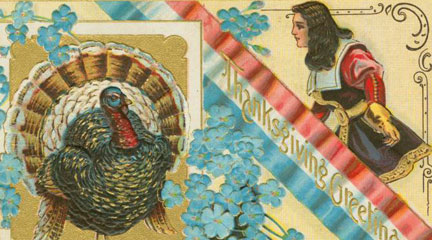
This lesson does a good job of positioning students to understand and evaluate the perspectives of secondary sources on the First Thanksgiving. Students begin by establishing a common understanding of the “mainstream narrative” of the First Thanksgiving, either from their own experience, books on Thanksgiving written for young children, or a website like this one from National Geographic Kids. (Other, similar sites are also linked near the bottom of the lesson).
In groups, students then read accounts of the first Thanksgiving from one of four points of view: mainstream accounts, Native American educators and public school leaders, conservative and Tea Party activists, and Native Americans critical of the holiday. Multiple articles are provided for each category so teachers may choose the articles most appropriate for their students. After analyzing each category of sources in small groups, students come together as a class to discuss the various perspectives of the accounts they read. This is an ideal opportunity for teachers to highlight the importance of paying attention to source information and reading historical accounts with a critical eye.
Some modifications may be necessary depending on your students’ ages, abilities, and background knowledge. Students may need additional background information on the sources depending on their familiarity with the different point-of-view groups. You may also need to modify some of the texts depending on students’ reading levels. Also, see the rubric below for more background information and historically accurate information about the first Thanksgiving.
The lesson concludes with a series of discussion questions that do a good job of helping students to think more carefully about the social and political impact of accepted historical narratives. For example, “What’s at stake in interpreting the story [of the First Thanksgiving]?” These questions help students start digging into why we remember the past in particular ways and compare stories about the past generated by collective memory with evidence-based accounts of the past.
Notes
Teachinghistory.org Lesson Plan Rubric
| Field | Criteria | Comments |
|---|---|---|
| Historical Content | Is historically accurate? | Yes. Requires students to compare accounts and judge evidence quality. |
| Historical Content | Includes historical background? | No. Teachers may want to explore additional sites. |
| Historical Content | Requires students to read and write? | Yes. Minimal writing but discussion questions could be writing prompts. |
| Analytic Thinking | Requires analysis/construction of interpretations using evidence? | Yes |
| Analytic Thinking | Requires close reading and attention to source information? | Yes. Understanding each source’s perspective is crucial. |
| Scaffolding | Appropriate for stated audience? | Yes. May need adaptation for younger students or ELLs. |
| Scaffolding | Includes scaffolding materials and strategies? | Yes. Thanksgiving Interpretations Handout helps organize and analyze. |
| Lesson Structure | Includes assessment criteria focused on historical understanding? | No. Discussion questions could serve as writing prompts and assessment. |
| Lesson Structure | Defines clear learning goals and progresses logically? | Yes |
| Lesson Structure | Includes clear directions; realistic for classrooms? | Yes |