Declaration of Independence: Rough Draft to Proclamation

We love the way this lesson challenges students to closely read and analyze the two versions of the Declaration of Independence. The two versions of the opening paragraphs of the Declaration are placed side-by-side, in small, manageable chunks of text. Even if a teacher were not using this particular lesson plan, this presentation would be especially useful in helping all students access an otherwise difficult text. Other reading and analysis supports include guiding questions and a step where the teacher models the process of comparing the juxtaposed texts.
The lesson begins with students looking at the first pages of the [original documents and answering questions that get at the historical context of the documents, before doing careful analysis of the transcribed prose. These procedures potentially convey the necessity of slowing down to read, question, and understand primary sources. And they do so using the Declaration of Independence, a document that all students SHOULD read!
As it stands, the lesson has plenty of opportunity for reading and discussion, but requires very little writing. Teachers may want to enhance the writing component of this lesson by having students write responses to some or all of the discussion questions. There is also an engaging extension activity that could be enhanced by requiring written responses.](http://www.loc.gov/teachers/classroommaterials/lessons/declaration/pdf/draft.pdf)
Notes
Teachinghistory.org Lesson Plan Rubric
| Field | Criteria | Comments |
|---|---|---|
| Historical Content | Is historically accurate? | Yes |
| Historical Content | Includes historical background? | Yes. Links to background information included, but assumes familiarity with political events. |
| Historical Content | Requires students to read and write? | Yes. Focuses on close reading of two versions. Teachers can insert writing tasks easily. |
| Analytic Thinking | Requires analysis/construction of interpretations using evidence? | Yes. Primarily in the final task, suggesting reasons for changes between drafts. |
| Analytic Thinking | Requires close reading and attention to source information? | Yes. Discussion questions require close, careful reading of both versions. |
| Scaffolding | Appropriate for stated audience? | Yes. Vocabulary is well scaffolded with opportunities to define difficult terms. |
| Scaffolding | Includes scaffolding materials and strategies? | Yes. Excellent discussion questions. Documents presented in accessible format. Teacher models the comparison process. |
| Lesson Structure | Includes assessment criteria focused on historical understanding? | No. Final task could serve as assessment, but no criteria provided. |
| Lesson Structure | Defines clear learning goals and progresses logically? | Yes |
| Lesson Structure | Includes clear directions; realistic for classrooms? | Yes. Text on this site is very small; teachers should adjust display settings. |
Related Topics
Documents from the Continental Congress and Constitutional Convention
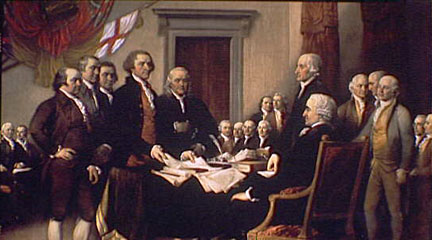
274 sources focusing on the work of the Continental Congress and the drafting and ratification of the Constitution.
Declaration of Independence
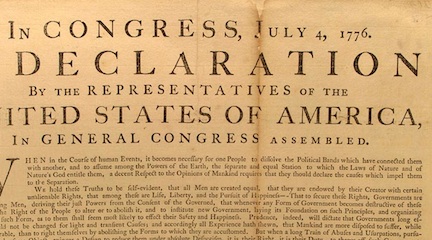
Historian Rosemarie Zagarri reads the Declaration of Independence closely, taking time to define its context and its …