Opening Up the Textbook: Rosa Parks
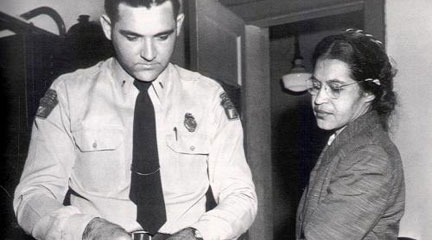
This easy-to-follow lesson cuts to the heart of historical thinking. Its strength is that it requires students to go to the sources in order to develop historical knowledge. Not only does it show students how public memory and history textbooks can oversimplify complex events, it gives students the means to craft their own textbook passage by drawing on specific textual evidence, including sources that contradict one another.
The simplicity and clarity of the lesson make it ideal for introducing both historical thinking in general and the Civil Rights Movement specifically. More experienced teachers may chafe at the lesson’s tight structure—so, they can create their own lesson by using the website’s multiple resources regarding the Montgomery Bus Boycott.
Of the two suggested writing assignments, Prompt One, which asks students to rewrite a standard textbook account, is particularly good. Prompt Two asks students to take a position for or against using a standard textbook. While this may prompt students to consider the implications of the traditional Rosa Parks story, it is also problematic. Would it be possible for a student to argue for and still receive a good grade?
Notes
Teachinghistory.org Lesson Plan Rubric
| Field | Criteria | Comments |
|---|---|---|
| Historical Content | Is historically accurate? | Yes. Current historians highlight Parks’s training as an activist. |
| Historical Content | Includes historical background? | No. The lesson purposefully does not offer extra background. Resources available at website. |
| Historical Content | Requires students to read and write? | Yes. Includes reading one secondary and two primary sources. Teachers choose from two writing assignments. |
| Analytic Thinking | Requires analysis/construction of interpretations using evidence? | Yes. Students create their own interpretation and question a textbook interpretation. |
| Analytic Thinking | Requires close reading and attention to source information? | Yes. Through looking closely at sources, students arrive at a complex understanding. |
| Scaffolding | Appropriate for stated audience? | Yes. Appropriate for high school; with modifications, could be used with younger students. |
| Scaffolding | Includes scaffolding materials and strategies? | Yes. If analysis stalls, teachers could prod students to look at dates and identify contradictions. |
| Lesson Structure | Includes assessment criteria focused on historical understanding? | No. Assessment strategies included, but not criteria. |
| Lesson Structure | Defines clear learning goals and progresses logically? | Yes. States its goals and progresses logically. |
| Lesson Structure | Includes clear directions; realistic for classrooms? | Yes |
Related Topics
The Montgomery Bus Boycott: They Changed the World

How was the 1955–1956 Montgomery Bus Boycott covered in Montgomery? Take a look with this archive from a Montgomery …
Historical Thinking Matters
Presents four guided investigations—on the Spanish-American War, the Scopes Trial, Social Security, and Rosa …