Jennifer Orr on Making Technology Work for Primary Students: Part One
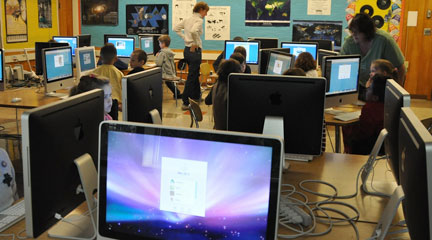
History and technology are both challenges with primary students. Let’s tackle history first. Young children struggle to understand anything that they can’t see, so comprehending people and life in the past is difficult. Also, they’ve only been alive for a few years so time spans of centuries are beyond their understanding. As a result, you often hear children ask, “Is George Washington still alive?” or “Were Abraham Lincoln and Martin Luther King, Jr. friends?” Deeper comprehension of conflicts or realities is even more difficult.
Securing the Benefits of Technology for Young Students
Children, no matter their age, should be able to continue and direct their own learning and exploration.
The challenges faced with the use of technology stem from young children’s pre-literacy. Many of the tools we use with students, such as blogs and wikis, require an ability to read and write, and to do so reasonably well. When I moved from teaching 4th and 5th grades to teaching 1st, this was a significant concern of mine. The ongoing conversations students were having on blogs and the recording of their learning, to which they could return throughout the year, on wikis seemed impossible with children who were still learning to read and write.
But I wanted those benefits. Children, no matter their age, should be able to continue and direct their own learning and exploration. They should not be limited to the time and ideas I set forth for them during class. So many things for young children are limited by the adults in their lives; I wanted to find ways to open up their learning as much as possible.
Feeding a Passion for History
In spite of the challenges inherent in using technology in the primary grades, I clearly believe it is important.
Finally, young children feel righteous indignation at the wrongs of the past.
That is also true for history. All children should have the opportunity to learn how people like them contributed to the world in which they live. They should also be exposed to things about which they could become passionate, even if for only a brief time. Many children love to have an area of expertise, something about which they know more than their peers or even some adults. I’ve watched little ones become obsessed about Greek myths, the Titanic, presidents of the United States, and Rosa Parks.
Finally, young children feel righteous indignation at the wrongs of the past. They are truly appalled by the idea of slavery, segregation, assassinations, and the need for the suffrage movement. I believe there is value in children coming to understand the past through a lens of righteous indignation. They are less likely to allow such treatment of others in their own lives when they have confronted their feelings about it through history.
Based on a firm belief in the importance of history and technology, I was determined to find a way to integrate the two with primary students. I will write more about ways to do so in an upcoming post, so keep reading. . . .
Related Materials
Jennifer Orr on Integrating History into 1st-grade Instruction
U.S. history doesn’t usually have its own place in 1st-grade curriculum. How can you integrate it with other subjects?
Jennifer Orr on VoiceThread
VoiceThread enables young learners to express their ideas without struggling to write them down, says 1st-grade teacher …
Jennifer Orr on Making Technology Work for Primary Students: Part Two
Conventional applications of Web 2.0 tools expect students to read and write confidently. How can you adapt these tools …