Third Graders Analyzing Historical Sources
Transcript
Heckart: So, things that were happening during this time period that we learned about that, is why you’re thinking that. All right. Let’s look at this one right now, at this picture that was Grant, Alicia, Emily, and Cassey, so those four people again, just like they just did: the who what when where why, what do you guys get as the gist of this photo on your KLL chart?
Student: We thought it was like these people that were working for the boss, the boy boss and that was the overseer and they were picking like heels or something like making shoes.
Heckart: I remember your group talking about him being the overseer and you were trying to figure out what this stuff is on the ground and you guys never really figured it out for sure but that’s whatever job they have. Am I correct in saying that? All right, Cassey and Grant, anything else you would like to add to that? Emily?
Emily: That the girls are working in the factory and it looks like it has bad conditions.
Heckart: Ah, why does it look like bad conditions?
Emily: Because there’s like stuff on the floor and it looks like the windows are shut.
Heckart: Mm-hm, it does. There are a couple of windows but it does look like they are shut there. What did you guys say about this girl? I remember you guys talking about her when I was in your group. Cassey . . .
Cassey: She’s a little kid and, um . . .
Heckart: And you were comparing her to your sister, I believe, when you were talking about it. So what did you predict her age to be?
Cassey: Four . . . Five.
Heckart: Yeah, so she’s not very old, and she looks like she is doing the work.
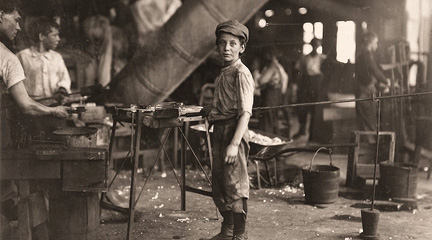
Heckart: A lot of people believed this was wrong and they organized a group called the National Child Labor Committee and they were encouraging to pass laws to protect children. This group had a problem. How could they get people to demand new laws? Without television or movies, there was only one way to show Americans what was going on and that was through photographs. The photographer Lewis Hine was hired by this National Child Labor Committee to take pictures of children working. Many of his photos are of children working in mines, mills, fields, factories, and city streets and it made people angry when they saw the pictures. Americans demanded change. Eventually this group was successful and all the changes came and laws were made. Now, what do you all notice? Nicole, what do you see?
Nicole: In the bottom picture is the same.
Heckart: Yes, that one is also the same as this one, isn’t it?
Class: They’re oysters! They’re oysters! He’s using knives!
Heckart: The picture caption for that one says four-year-old Mary—you were predicting her age—opens oysters with a knife. A four-year-old with a knife!
Class: Oh my gosh! She could kill herself—
Heckart: Give me five. Let’s read a few more picture captions and then we can talk about it, all right? This boy right here is 15 years old and he’s a glass worker. Hine notes he worked for several years, works nine hours a day, day shifts on one weekend, night shifts the next week, and he gets $1.25 a day. Now, glass blowing was when they would actually, this is the other side of it too, where they would stick—this is another picture from the glass factory—and they would stick those things into the hot coals so they were working with fire, these children were. Okay, here’s another picture. Carrying in boys, these young boys worked long hours in the great heat in an industrial glass factory. This one right hear is an eight-year-old, Jenny, she’s a cranberry picker; she spends her days out there, all day long picking cranberries. Okay? These boys down here are textile mill doffers and sweepers. Doffers were often injured changing bobbins filled with thread.
Student: She looks small for an eight-year-old.
Heckart: She does look small. Now, why might she be smaller than most eight-year-olds?
Student: She doesn’t get a lot of food.
Heckart: She doesn’t get a lot of food and what is she doing all day? Working!
Heckart: We have learned to find more about it. This is an excellent book and we did not have a chance to do every single photo analysis of every photo.
Student: But we should.
Heckart: You might even want to look through this book to see even more. So if you are wondering more about your picture, this would be the place to do it. Now, he was the man who really then helped get child labor laws to be all over the United States. In 1924 is when they really started happening in the United States. So in 1924, it started making these kids doing illegal things. They said no, they have to go to school, they have to get an education. So out on the timeline, what do you think we should put out there?
Student: Child labor.
Heckart: Child labor laws started in 1924. A few states had them before then but not all the states did. So if we put that on there then we’ll say 1924, we know these things happened before or after that? Before or after that?
Class: Before.
Heckart: Before, because after 1924, were they allowed to do that anymore? No. All right, lots of people have things that they would like to say. Bryce?
Bryce: So if Lewis Hine and all the other people didn’t do anything, we would be working instead of going to school?
Heckart: Possibly could have lasted longer, couldn’t it? Yeah, true. Zack?
Zack: I have a connection with that picture. It’s in Children at Work, it’s in that picture.
Heckart: That’s right. We have a guided reading group who’s reading the book called Children at Work and a lot of those pictures, you’re right, are Lewis Hine’s pictures in your book in Guided Reading Two. Great connection. Other Zack?
Zack: That little square box on the corner is that girl on the . . .
Heckart: It’s that little girl right here, they just did a close up on her, didn’t they? Yes.
Student: I have a question. When you were born, um, if you were around that time where would you go?
Heckart: If you were a baby, you mean? Well, often, if you notice this lady right here, that’s her mom. So they took the babies to work with them. If they were a baby they might put them, like, in a little papoose thing and tie them to them like in those blankets. Have you seen those before? And a mother will always tie them on to them. Okay? They would take the small children with them.
Student: Ah, they could die!
Heckart: That’s why, when they were old enough to do something, they started working, too. Okay?
Student: On the front, is that like someone taking off those bobbins?
Heckart: Yes it is, that’s a doffer. You’re correct.
Student: Um, so were they striking during this time?
Heckart: Yes, they were.
Student: Because this was four years after women got to vote.
Heckart: Right, so women are still working for some equal rights, aren’t they? Didn’t come over night. Just like—have we learned that did any amendment just change everything just like that?
Class: No! People have to vote for it.
Heckart: It took some time, so you’re right. The law started there but then they had to start enforcing them to get it to stop.
Student: Like, um, the 16th amendment Abraham Lincoln he was, uh, I mean the 13th Amendment, um—I was thinking of the president.
Heckart: You were thinking of the president, yeah. The president—he was the 16th president, you’re right. Okay, 13th Amendment what?
Student: Slavery is not legal in America, and it took like three years or something, or even more, to change that law.
Heckart: Yeah, because what started happening then?
Class: Segregation.
Heckart: Yeah, segregation and how long did segregation last?
Class: A long time. A hundred years.
Heckart: Close to a hundred years, right.
Heckart: Then we added a piece this year. Each year I try and just go a little bit further with what I have learned since 2001 and say, okay, how could I make this be a little bit better? That’s just a strategy that all teachers do is trying, and once you’ve tried something, “How can this be better the next year?”
So I went to a conference in Houston at the beginning of the school year and a lady from the Library of Congress shared with me a thing called Books as Hooks. And so what she did was she took primary sources and showed the kids the primary sources before she read a book to them to get them interested and hooked on it. So I thought that was an interesting concept. So, when I came back to my classroom I decided I was going to try it, but we were working on the reading comprehension strategy of inferring at that time. So I decided to add that piece to it too. So I pulled different primary sources; both documents, photos, and a few artifacts, too, then and pulled those together and the kids analyzed those and they have different pieces of paper that they do that on.
It’s mainly looking at who? what? when? where? why? Something is happening in a photo, or in a document or in an artifact. So just thinking of those questioning strategies there then I pull that into a document analysis, a photo analysis, an artifact analysis, so that each kid gets to see each of the documents, each of the artifacts, and then from there they predicted as a small group what they thought that photo was going to have to do with. Because I didn’t tell them what book we were going to be reading or anything about it. I wanted to see what their background knowledge was on it first.
So they made some predictions and after we predicted then, when I’m reading the story, then I’d stop at different places and I’d let the kids make connections or infer what those artifacts have to do with the story or the time period that we’re talking about. I think it’s the best way that I have ever taught inferring because they completely understand and it’s a very easy assessment for me to see who can make the connections and what their inferences are just by what they’re saying.
And I’ve also found that kids that maybe had a difficult time doing it, once they’ve heard another student made a connection, they’re like, “Oh, I’ve got something else I could add to that or I could add on to that.” And so, just being able to talk those things out, it’s made other kids who are more quiet and reserved be able to then share during that time too. So it’s been a very successful project.
In these clips from Kimberly Heckart’s 3rd-grade classroom, we see students learn about child labor during the Industrial Revolution. In carefully sequenced activities, students analyze photos taken by Lewis Hine, consult secondary sources to build background knowledge and answer questions, and generate connections.