Thomas Nast Cartoon
Transcript
I was really stunned by the other half of Reconstruction, which we never paid any attention to, which was the money debate. There was a huge debate about money during the same time—these were these great issues: what do we do about the ex-slaves and what do we do with the money? Because the North used greenbacks to finance the Civil War; they didn’t want to tax people, so they just printed money, they made it legal tender. I think 240 million dollars in greenbacks, which are purely paper money—they have no value other that what people are willing to believe is in them. And they’re very successful during the war: they don’t cause a lot of inflation, they allow Lincoln to prosecute the war without having to raise taxes, and keep the sort of massive dissent under control.
But after the war what do you do with them? That’s an interesting question. One argument is you just get rid of the greenbacks—they’re not real money; they don’t have any real value; they’re a lie; they’re a fraud and a cheat. “Burn ’em,” some people would say. “Contract them” and—they call it contracting the currency—“bring ’em back in and burn ’em, destroy them and go back to real money,” which at the time was supposed to be gold. And the other argument is that we need more paper money—money is just a social convenience—it’s whatever we say it is, and we should get rid of gold. The document comes out of that debate—it comes out of this debate about the nature of money.
And as I started to look at it, I got really fascinated by that question. I mean, why not use paper money? What’s the argument for gold? And when I started to read the arguments for gold, they became really fascinating and absurd. I mean they’re superficially rational. Economists in the 19th century would go through this long rational explanation about prices and supply and demand and then you’ll finally get to the core of the metaphor, which is gold just is valuable, because it is. And that’s always there: it just is. And sometimes they’ll say, God made it to be money. And they’ll say this; I see this again and again: God made gold to be money. Okay, this is the money, this is going to be burned for heat, I mean it’s really…it’s that clear. And there’s this what you’d have to call a fetish about gold. That it has this magical value—that’s independent of what people think—it just has this magical value. And I got really interested in that question.
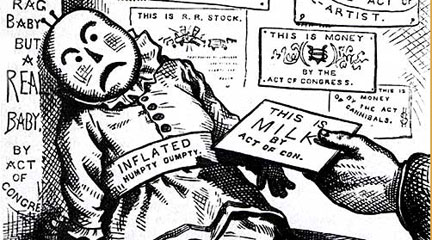
So this Nast cartoon was produced as part of the attack on paper money. Nast was a really strong hard-money guy, and he referred to paper money as the “rag baby,” that was his name for it. Cause paper money was also referred to as “rag money.” It was made out of rags—old rags, rags and trash, and inflated paper trash he’d say. This was part of an argument against paper money. And it’s a really good expression of the gold standard position. It’s a really strong expression of the gold standard position. And because Nast is good, it’s pretty coherent.
What does it embody? Well in this thing the rag baby cannot embody a real baby. He’s pointing out the futility of trying to embody qualities in things they don’t have. And it’s connected to forms of economic prosperity—like this is a house and lot—these are symbols of economic success. Or this is a cow, which I think refers to farming—you know it refers to the sentimental symbolic place farming has in American life, it’s where real values are, it’s where real work comes from. This is money by Act of Congress, this is milk by Act of Congress—you can’t feed yourself on pure paper—it’s not a rag baby, but a real baby. So it became a really good embodiment of the problem of substituting signs for things. And it seems like a pretty straightforward, and generally commonsensical point of view. I mean you can’t hand a baby a milk card and get a baby to drink it. I mean it’s a witty expression of that.
But because of the structure of it, with the signs, it’s really also, I think, critique of advertising in the 19th century, and the emerging culture of mass sort of…signage—advertisements, placards, billboards, competing signs. It’s also a comment on the chaoticness of post-Civil War life. And so it’s not just commenting about money, it’s also commenting about, what would you call it? The virtualness of industrial capitalism. Industrial capitalism is increasingly virtual, where you market something as a chair that looks like a handmade chair but it’s actually stamped-on pressed and there are 20 thousand of them. The watch looks like it’s gold but it’s actually plated in some new technological process. There’s a quote from Henry Ward Beecher where he says that we live in a culture of lies—lying flour in our bread, our clothes are lies: they look like things they’re not. And it’s partly a commentary on that commercial world. And it uses money as the door to open that kind of critique.
One of the things that’s unconsciously revealed here is a certain amount of anxiety about reproduction. Why choose a rag baby? Why choose to embody it that way? A baby in some ways is a symbol of concreteness. It’s a new life but it’s made out of two other forms of life, and its unimpeachably real. It’s the symbol of a kind of realness, and the idea of declaring something a baby which isn’t a baby, is kind of the ultimate expression of the arrogance of people. You can’t create life—life is the most basic thing you can’t make—and you can’t make a baby out of parts or pieces. So it has something…it’s not unlike Frankenstein—it seems to me it has some of that same concern about generation and reproduction.
So one of the things I’d say is that it’s not an accident that he chose a rag baby. And you could say, it has a lot of values; on the one hand it mocks children’s fantasy play, and it says that paper money is a child’s foolishness, sort of a foolish childish act.
It was the most naked, I think, and frank description of the gold standard position. You can’t substitute paper for the real thing. An idea can’t be a thing. A thing has to be something material. But of course, in fact, it’s an economy where a house and lot is just a piece of paper. And in fact, the ownership of the house and lot is purely a fictional paper title. Ownership doesn’t exist physically, it only exists in law. It only exists in custom. And for the purposes of the market a paper representation of a house and lot is exactly as good as a house and lot. So that was sort of interesting to me. The cow—obviously you can’t milk a piece of paper, but you can buy and sell symbolic cows which are nothing more than pieces of paper. And from the perspective of the greenbackers, the money itself is an embodiment of all these other tangible physical goods, which are part of the United States. So it seemed like a nice way to get at both a really strong expression of the gold standard position and some of the incoherences of it at the same time.
The first thing I’d ask them is why did he choose to make paper money into a rag doll? What are the rhetorical strategies of this thing? And the claim that paper money is a rag baby is an interesting claim to make; I mean why does he choose to symbolize it that way? Why not call it, you know, a scarecrow? Why a baby? Why a rag baby? And then I’d ask why would he want to have it in the form of this weird impossible situation of a shelf with signs put around it. I would want to ask them why the argument takes that form. Try to get them to say, “Well, maybe it has something to do with the commercial street, and the world of signs and advertising.”
If I had to describe a methodology, I’d say you have to have some factual context. You have to understand why certain terms appear. You have to know what’s going on in the era the document appeared in, but beyond that you want an attitude of skepticism about the rhetoric, about the strategies of argument the document makes. You want to be able to question not just the points the argument makes, but the means by which the arguments get there. The more complicated way to say this is you don’t just want the answer to the question—you want to know what does asking that question do? What effects does asking that question produce; what kind of outcomes does that question always point towards?
The first thing I do when I’m talking about reading images is I say there’s absolutely nothing in an image that can be taken for granted. And if you’re going to read it, you have to go sector by sector. You have to ask the “why” question about every piece of an image. Why is this particular thing here and not somewhere else? Why do you choose to draw it this way? You have to really interrogate images. I mean that’s the basic method I want to bring when I’m using an image. There’s nothing in it that’s a product of chance—well, if there is something in it that’s a product of chance it might be more interesting than the things that are in there deliberately.
The first thing they’d want to do is take careful notes, either on paper or mentally, about what the thing depicts and how it depicts it. And sometimes just writing it down is a big help. You know, it’s a baby and it’s in front of…I find when I’m taking notes, that when I write down the image I often learn a lot about it. So the first thing they want to do is give it a careful formal study of the structure of the thing—what is it depicting and how?
You have to have some sense of what the historical references are. So if they see this as railroad stock, they would have to investigate something about railroad stock and feelings about the railroad in the 1870s. They’d have to discover some sense of historical context. But I’d also want to know something about Nast. Particularly because he’s such a…there’s so much stuff by Nast, and he has such a strong influence. He’s a very powerful artist. I would want them to investigate how else Nast depicted babies; how else he depicted money; how he depicted business and finance in general. So I’d want them to have some sense of the author, and the author’s characteristic forms of…his rhetorical tricks—the author’s characteristic rhetorical style. And how does this deviate from his characteristic style.
I would ask them to look for other iterations of that phrase. You know, where else does “rag baby” show up and who else uses it? Well, one thing I’d ask them to do is look at how else Nast drew babies. I mean what else did Nast do with babies and how else did they appear in his work. Did he sentimentalize them as the exact opposite of this? Or, how were babies depicted in the popular culture generally? And I think the answer usually is they’re highly sentimentalized. They’re the objects around which real feeling is generated, and the objects that represent genuineness. So I’d ask them to contextualize it—what is the context of babyhood?
U.S. citizens today are all familiar with “greenbacks,” the paper money we use to conduct daily business. We’re even comfortable with electronic money! But in the late 19th century, not everyone was ready to accept greenbacks, originally issued during the Civil War, as “real” money.
Michael O’Malley analyzes an 1876 editorial cartoon by Thomas Nast that criticized greenbacks and “greenbackers.” How did Nast use symbols in his cartoon? What context was he working in?