Smithsonian American Art Museum: "Westward the Course of Empire"
Transcript
Suzannah Niepold: Here’s what I’m going to do, I’m going to split you right down the middle here, and I want this group just to look at the land—and just look at the land, ignore the border that goes all the way around the side, but just the land in the main part of the painting. Try to figure out what story it’s telling and how it’s telling it. We talked a lot about light and dark and that’s really key here. This half, I want you to look at the people. Again, ignore the border, but just the people in the main part of the painting. Who are they? What are they doing? How do they help tell the story? [Teachers commence group discussions]
[Group 1:]
Teacher 1: You see men chopping with their axes.
Teacher 2: Clearing their way.
[Group 2:]
Teacher 1: It looks like the Sierra Nevada, doesn’t it?
Teacher 2: Yeah, it’s still the Sierra Nevadas, I agree with you on that.
Teacher 3: Coming here, and there’s the promised land.
Teacher 2: The promised land is out there on the other side of the mountains.
[Group 3:]
Teacher 1: Yep, they’re all trying to cut a path through.
Teacher 2: I mean that’s what they’re doing. They’re all looking towards the sunlight. Actually it’s probably California because they’re coming out of the mountains.
Teacher 3: The Rockies.
Teacher 1: But yeah, they’re forging ahead. That’s what they’re doing.
Teacher 2: So this is along [indecipherable].
Teacher 4: I like the two guys who have reached the top of the mountain.
Teacher 2: “We’re here!” [Suzannah Niepold transitions to large group discussion]
Suzannah Niepold: Let’s start with the land groups. What can you tell us about the land in this picture?
Teacher 1: Going from the darkness over here on the right, to the valley, it’s very dark, cold colors—the blues and the purples right there. And it’s coming in, it’s getting golden, then it transitions over into the yellow and it gets brighter as it goes over. It’s inverting, you’ve got a triangle with a peak at the top on the right, and then a peak at the bottom, [so] the landscape balances. And you have that division with the landscape . . . it reminds us of Moses parting the Red Sea, taking my people to the promised land.
Teacher 2: You’ve got the mountains, too, the hardship of coming over mountains; and then the valley below on the left. So that the promised land, the easy land, is on the left, and the hardships are almost behind them.
Suzannah Niepold: Now this group you got up to go check this, right, was it hard to see? There’s a burial scene—there’s a cross that someone has erected right here, and if you follow the cross down there’s a burial going on. It’s one of the harder things to see. What else?
Teacher 3: You’ve got the guys on the left with the axes clearing the way for the people to go through.
Suzannah Niepold: Okay, so, they’re sort of the head of the party, right? They’re the one’s clearing the way. What else?
Teacher 3: We kind of thought it was interesting that the gentleman that seems to be holding the woman and the two children, she’s got her hands like in prayer. He’s the only one with that hat; he’s the only one that’s clean-shaven, that’s an older-looking man, because the other ones are really young. So we almost said that maybe that he wasn’t really there, maybe he’s more like a guardian angel, since behind it’s the burial scene. That he’s pointing their way—she’s in prayer, which is kind of symbolic of that. And he seems very calm, he’s like the only one that’s calm and just like, “This way!”
Suzannah Niepold: So his role is important because he’s pointing out the way. How does the artist make sure that you see this group? This is kind of an important group.
Teacher 4: The woman’s got a white shirt on.
Suzannah Niepold: So you’ve got that bright contrast there. How else?
Teacher 5: There’s really nothing behind them other than the bright light.
Suzannah Niepold: Yeah, that’s another real key—you notice that his head and his hand, there’s nothing really busy going on behind it so it really stands out.
Suzannah Niepold: The next thing that we’re going to do is basically look at the same painting all over again, but here’s the difference. This is actually just the study for a mural—this is like a sketch. And it was completed in 1861. The same artist painted the same scene; but instead of it being a painting, about yea big, it was a huge mural, wall-sized big. And it’s in the Capitol Building; it’s in the House of Representatives. So what I want you to do in your groups is compare the two and find the differences, because there are some pretty major differences between the two. [Visitors commence group discussions]
[Group 1:]
Teacher 1: Look at the head wound though. The head wound is barely a speck of blood in the first one, but then look, it’s almost like—
Teacher 2: They all look younger; even this man looks younger. Every one of them look younger.
[Group 2:]
Teacher 1: It’s like there’s . . . there’s like smoke coming out right here.
Teacher 2: Like in the distance there? But look at the difference in the mountains. Does that mean their struggles are less maybe? In this image the struggles being less. And are there more people?
Teacher 1: It’s spread out more.
Teacher 2: Also notice what happened to the horses. Because historically they didn’t use horses, pretty much they used oxen. So I guess he corrected it historically.
[Group 3:]
Teacher 1: I noticed the pose . . . the posture is different. It’s almost more—his back is flatter, rather than more of a relaxed pose in the previous one. Here he looks like he’s riding faster, or he’s tired.
Teacher 2: To me it looks like he’s shocked, he’s like, “Oh my god, is that really it?” And in this one it’s like “I can’t see it.” [Suzannah Niepold transitions to large group discussion]
Suzannah Niepold: Why did he take the burial scene out, do you think?
Teacher 1: I think he lessened the harshness of the trip in lots of different places. The mountains are lower, so less of a hassle; there’s greenery on the right side that he didn’t have in the first one. So I think he’s lessened the hardship of the journey. And that would be one way to do it.
Teacher 2: And they’ve lowered their guns. In the first one the guns are up more, in this one they’re down more.
Teacher 3: What’s the significance of the smoke in the [back]ground? Is it to show that there are more people moving west?
Suzannah Niepold: Possibly. What else could smoke in the distance be?
Teacher 4: Industry.
Teacher 5: Indians.
Suzannah Niepold: Indians. Why would he add American flags? [Unintelligible response]
Teacher 3: So he’s in the middle of the Civil War.
Teacher 6: He’s also got more historically correct because he’s got oxen rather than horses.
Suzannah Niepold: Ahhh, yes!
Teacher 3: Everyone looks younger, and it seems like—
Suzannah Niepold: Yes, I’ve noticed that as well. Why would he make everyone younger? What does that do?
Teacher 7: To try to encourage the current age group to go that way?
Suzannah Niepold: So it’s encouraging people to go out West. Remember this is—
Teacher 6: It’s for the same reason he took the burial scene out; you don’t want to scare them. You want to make sure that you can go, but everybody will live.
Teacher 3: I think their dogs are interesting too. They have dogs in the painting. I guess it’s a “you can take your pet with you!” kind of mentality.
Teachers: Bring your animals! Pets allowed!
Suzannah Niepold: Sure. Sometimes in things like this I wonder . . . I mean if we’re looking at this in real life it is now huge; and I wonder if translating it from this—which is isn’t too much bigger than this reproduction—to the huge size if he’s like, “Wow, there’s a lot of space to full. What do I put in there?” There is a great video; an art historian who used to work in the museum—who actually used to be the director of the Birmingham Museum of Art—did a great little 10-minute video on this piece where he explains everything. So incentive for you to contact me and keep up with it, I can send you links to all this great stuff.
Suzannah Niepold guides TAH teachers through analyzing the differences between Emanuel Gottlieb Leutze’s original study for Westward the Course of Empire Takes Its Way and his final mural in the U.S. Capitol.
Related Topics
Smithsonian American Art Museum: Teaching with 19th-Century Art
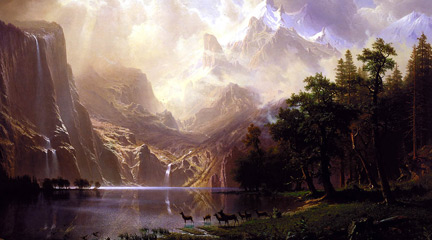
Watch Suzannah Niepold of the Smithsonian American Art Museum guide teachers in analyzing four works of art.
Images of Native Americans
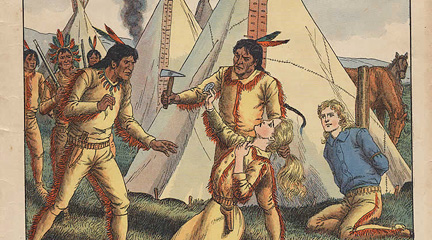
Illustrations follow European interpretations of Native Americans, through images from popular culture, literary and …