Smithsonian American Art Museum: Teaching with 19th-Century Art
Transcript
Suzannah Niepold: Alright, gather up where you can see this painting. I’m covering up the label on purpose; I want you to look before we get any sort of background information. What’s the whole picture about?
Teacher 1: I begin by looking for what’s underneath the rainbow.
Suzannah Niepold: Okay. What is underneath the rainbow?
Teachers: A home. A church; it looks like a church.
Suzannah Niepold: So you notice this tiny little house, sometimes that takes a while to see. And that’s at the foot of the rainbow; so what’s that about? Why did the artist do that?
Teacher 2: Well, homestead. Out west that was the big American dream—have your own land, have your own house, and not be subject to anybody’s control.
Suzannah Niepold: Fantastic. So that’s the American dream—to have your own spot surrounded by land. Okay. What else do you notice? We’ve used the words beauty, paradise, how else would you describe this particular landscape?
Teachers: Vast, open.
Teacher 3: You’ve got two little [unintelligible] over here. I mean, it’s not totally alone but it’s pretty [unintelligible].
Suzannah Niepold: You’re not totally alone, but you don’t have right next-door neighbors to deal with. The house is really small; it is really hard to see. What does the artist do to make sure your eye goes there eventually? How does he point it out?
Teachers: The rainbow.
Suzannah Niepold: Right, it’s right at the end of the rainbow. But that really wasn’t enough for him. How else does your eye go there?
Teacher 4: You’ve got that slope coming from here too that angles up.
Suzannah Niepold: You have what coming up?
Teacher 4: The slope, the road. It comes up right here and you’ve got a lot of water right here.
Suzannah Niepold: Absolutely. [unintelligible mummers and answers from visitors]
Suzannah Niepold: Fantastic, you have all of these lines—this little sort of drop of light leading up here, the water, the path, the pointing. So that really let’s you know that this is the main subject of the story. It’s kind of the American dream. The title is Landscape with Rainbow, it was painted in 1859, and the artist is Robert Duncanson, Robert Scott Duncanson. So, if this is painted in 1859, why would you choose this subject at about that time in American history? Lets consider, first of all, what’s going on. . . .
Teacher 5: People are beginning to go West, also.
Teacher 6: The American dream, with all the politics going on, is in some ways disappearing.
Suzannah Niepold: The American dream, this idea has come up several times, so that’s really maybe challenged, is that what you’re saying?
Teacher 6: I’m saying with the conflict, the regional conflict, some of the ideals of America are in question.
Suzannah Niepold:: The other thing to add that isn’t on this label—but it is available on our website in the biography of the artist—is that this artist is African American. Does that change the painting for you at all? Okay, I’m hearing “Oh, oh, interesting.”
Teacher 3: Going north to the promised land.
Suzannah Niepold:: So it’s not just the American dream, it’s the promised land?
Teacher 1: Yeah, but then why would he put two white people there?
Teacher 3: Dominant cultures.
Teacher 2: Because he’s hiding behind his work. His work’s not going to be respected. He’s an African American. So he paints white people on it because a white man’s going to look at a painting with white people in it, they’re not going to look at a painting if there’s a black one in it.
Suzannah Niepold: It’s going to change the meaning. If you’re thinking of contemporary viewers, you’re right; it’s going to change the meaning. Duncanson was funded by abolitionists, and their goal was to show how ridiculous this idea [was] that a race was lesser by showing how skilled an African American artist could be. So he’s showing off technical skill, as well as maybe this dream—this kind of American dream on the eve of the Civil War. There are kind of three eras of African American art. Everything before the Harlem Renaissance in the 1920s is kind of what you see here of trying to say, “We’re just as good; this is ridiculous, we can do everything that you can do.” It’s not until the Harlem Renaissance that it’s saying, “We don’t have to show your world, we can show our own.”
Teacher 1: Wouldn’t you like to just be standing right there on the water?
Teacher 2: Okay, that’s the whole point. That’s what you’re supposed to do. That’s what he was doing. He’s been on traveling shows to encourage people go to out West.
Teacher 1: Oh!
Teacher 2: So you got it.
Suzannah Niepold: In fact the way the curators hung this, with this curtain here is meant to kind of hint at that history. And that Bierstadt painted these giant landscapes and that he would tour with them, and he would keep them behind a curtain and you would pay admission. Then he would whip back the curtain. But how does Bierstadt accomplish what we just talked about? How does he make you want to step into this landscape and just say, “Wow!”
Teacher 2: Its size.
Teacher 3: It’s a huge picture. It’s not just a picture [where] you’re like, “Hey, I wonder what that is?”
Teachers: It’s like a window; it looks peaceful.
Suzannah Niepold: Peaceful. How does he create this idea of peacefulness?
Teachers: The deer; the calm water; calm waterfalls; the light; the soft clouds; the softness of the whole picture.
Teacher 3: It’s almost alluding kind of like Heaven and angels right where all the top comes out and the clouds are. You kind of think you would see this in a church or whatever, and a church is supposed to be one of the most peaceful places.
Teacher 1: And everything goes up. All the trees go up, the mountains go up, everything is pointing up.
Suzannah Niepold: Things that you notice and the specific details that you’re pointing out. Like how still the water is and how the deer—they’re not spooked, there’s nothing coming up behind them. And we have this . . . some people call it the “Godly light” kind of peeking through. What role does God play in this period of American history? Why might he have a part of this landscape, or why might he. . . .
Teacher 1: Manifest destiny. God wants us to go there.
Suzannah Niepold: Manifest destiny. God wants us to go there.
Teacher 2: When was this painted?
Suzannah Niepold: Look at the label over here.
Teachers: 1868.
Suzannah Niepold: 1868. Yes, it’s called Among the Sierra Nevada. So it’s California in 1868. So, again, why might he paint this in 1868?
Teacher 3: It’s after the Civil War. It’s a calming . . . well, it’s supposed to be calming because what’s really going on between the South and the North during Reconstruction still is not very calm. And this is an escape. It’s an escape for everyone.
Teacher 4: But it’s also the year that the Transcontinental Railroad is finished.
Suzannah Niepold: But it’s funny that you don’t see any of that, right? You don’t see the modernity, the advancement of civilization has no place here; it’s still this ideal. And I think it’s going to what you’re saying is that the Civil War ripped up the East Coast. If you search our website for Civil War photographs, we have plenty, you’ll see just destroyed landscapes. You just walked down that hallway past Niagara and all these sort of “New Eden”-y paintings. We sort of saw ourselves as the new world, new opportunity, and the Civil War maybe destroyed that image a little bit. And so the East Coast loses its “shininess” and we start looking out here for our peace and our majesty and our hope.
Teacher 1: May I?
Suzannah Niepold: Go ahead.
Teacher 1: It’s like a staircase almost, with the sides. It goes up there, and it goes on, and it takes you into. . . .
Suzannah Niepold: To make sure your eye goes all the way back there.
Suzannah Niepold: Okay, let’s start with this one just by looking at the right-hand side; just block out—just pretend the other half isn’t there. Okay, so, it’s nice and peaceful, how else would you describe it?
Teacher 1: Old-school. You see the boats with the sails and the hand fishing in the rowboat. It’s kind of the way they’ve always done it.
Suzannah Niepold: Okay, so the way it’s always been done. And what is being done? What’s going on on these boats?
Teacher 2: In the front one they’re fishing.
Suzannah Niepold: And how are they powered?
Teacher 3: It’s manual.
Suzannah Niepold: Still on the right side. So [by] oar. It’s manpower.
Teachers: Sailing; wind; natural.
Suzannah Niepold: Alright, switching to the left-hand side, what do you see over there?
Teacher 4: Pollution.
Suzannah Niepold: Yeah, it’s funny when we look at it with our eyes you see smog, pollution, this horrible environmental travesty. How might they have seen it in 1866?
Teachers: Progress; power of progress.
Suzannah Niepold: So you have to consider the transition in how our modern eyes see things versus how they might have been perceived back then. Different kinds of power—maybe steam power, progress, industry. Look at the landscape on both sides, how is it different?
Teacher 5: This over here [on the right] is clear, you can see…
Teacher 6: It’s greener.
Suzannah Niepold: So which do you think the artist liked better, the “old school” or the “new school.” Which did he support in this painting and how can you tell? I don’t know the answer to this. It’s a matter of. . . .
Teacher 1: To me it looks like old school because he paints that front rowboat so very, very clear; sitting from back here you can see just about every detail of the gentlemen.
Teacher 7: But the industry is made larger. It’s much larger; more powerful. And it’s closer to you. So he wants you to look at this.
Suzannah Niepold: We talked some about light and dark, and how artists can use that. Which side has the sunlight?
Teacher 5: They both do. You’re focusing here, and then you’re focusing there. It’s almost like you’re doing this—
Teacher 7: When you look at the sky, this one is lighter [right side]; but when you look down, this one is lighter [left side].
Teacher 5: Yeah, on the water. He’s presenting both sides of the issue. [Indecipherable, multiple teachers talk at once]
Teacher 1: It’s like you said, most of the sunlight is on this side [left side], but look at the smoke coming from it. It’s changing it, it’s turning it dark.
Suzannah Niepold: I want to come back to what you were saying though; because look there is sort of this blue sky up here, and here it’s the man-made smoke that’s covering that up. But here [right side], we have the natural storm. So again, he’s almost setting up that equivalent.
Teacher 8: Well, you just said the word storm. Is the storm bringing in this change?
Suzannah Niepold: You came from Gettysburg—am I right about that?
Teachers: Yes ma’am; yeah.
Suzannah Niepold: So the Civil War is fresh in your mind, right? This is a tiny little scene of Appomattox—feel free to come closer, maybe, you know, take a look, and then let someone else come in. It is a challenge sometimes to work with these much smaller paintings. This is the scene of the surrender; Grant and Lee are meeting in order to officially end the war. Although of course, it wouldn’t exactly end right at this moment. How has the artist chosen to present the scene? If you’re all the way over here, feel free to come in and fill in the front.
Teacher 1: You can tell who won.
Suzannah Niepold: You can tell who won. That’s very interesting. How can you tell who won?
Teacher 1: Well, because the Union soldier is in the front, and he’s got his hand on the desk and his whole chest is facing out towards the audience. It’s almost like a teacher stance with somebody, if you’re scolding a child. You’re looking at them like, “I can’t believe you just did this.” That’s what he’s doing. Because Lee was such a highly regarded officer in the military at the time, it’s almost like he’s looking at him like “Why did you do this to yourself, and to us?” Kind of like he’s being scolded.
Suzannah Niepold: What about Lee though? It’s not exactly like he’s cowering in a corner. How does the artist show him? How did he show this highly respected, regarded man in this tough moment?
Teacher 2: I think he’s got his hands up like, “I can’t believe I had to do this, that it came to this.”
Suzannah Niepold: So it’s very hard for him to do this. What else do you notice about the scene?
Teacher 3: You’ve got light right on the midline. So that . . . I don’t know if that means like, the light, the focus is in the middle where they’re agreeing, maybe, to quit fighting.
Suzannah Niepold: That is, maybe, the highlight of the moment where the two sides are coming together. And let’s use that to talk about composition. It is two sides, right? With the uniforms. How are those two sides equal? Are they?
Teacher 4: We’ve got three soldiers on one end and two soldiers on the other end.
Suzannah Niepold: Okay, so there’s a little bit more weight over here. Even if you just look at the height of the two generals, [it’s] roughly equal the way they’re presented. You’re right that Grant is slightly forward in that sort of authority stance. But if you look into surrender orders, the fact that Lee was allowed to keep his sword is a huge step. What does this say about what the North was hoping for the end of the war? The way that this scene is presented in terms of a surrender. How did they want to treat the South now that everything was over?
Teacher 1: In this moment, it looks like they want to . . . it’s like brothers fighting, [it’s] done, over, let’s go back to the way things were, let’s forget about it. And of course we’re history teachers, and we know that doesn’t actually happen.
Teacher 4: Yeah, but when you look at this guy’s—
Teacher 3: He’s not real happy.
Teacher 4: [He’s like,] “Hey, you know, I really don’t care about this.”
Teacher 3: Grant wasn’t wearing his general bars.
Suzannah Niepold: A few things are historically accurate. We know that he had mud on his pants, he had rushed there on his horse.
Teacher 3: He had borrowed a jacket, so he wasn’t wearing his general’s jacket.
Suzannah Niepold: But he wasn’t wearing his general’s jacket. So anytime you see an inaccuracy—or you see something you know is actually wrong from the way it happened. For me, that’s actually the most valuable part of an artwork because that’s pointing out a decision that the artist made in order to help tell a story.
Teacher 3: Washington Crossing the Delaware.
Suzannah Niepold: Exactly! So actually if we read the accounts of this scene, and there are many of them, there were a ton of people in this room. So why might the artist have chosen just to show a few?
Teacher 3: Make it more intimate.
Suzannah Niepold: How does that help tell the story.
Teacher 1: He had to illustrate the significance of the famous Lee having to surrender, which ultimately became the turning point in the war.
Suzannah Niepold: Okay, so it highlights him more if there are fewer people in the room, okay.
Suzannah Niepold of the Smithsonian American Art Museum introduces a group of TAH teachers to four paintings from the 19th century. Niepold demonstrates techniques for analyzing art, including researching context, examining one piece of a picture at a time, and looking for inaccuracies in historical scenes.
Related Topics
Smithsonian American Art Museum: "Westward the Course of Empire"
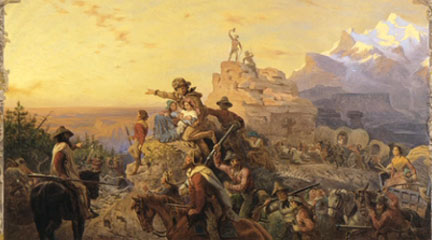
Watch Suzannah Niepold guide TAH teachers through analyzing the differences between two versions of Emanuel Gottlieb …
Images of Native Americans
Illustrations follow European interpretations of Native Americans, through images from popular culture, literary and …