FDR's Second Inaugural Address
Transcript
Well, the document that I have here in front of me is a copy of Franklin Roosevelt’s second inaugural address—delivered in January 1937; and it happens to be the first presidential inauguration that took place in January. Since George Washington’s time down to the ’30s inaugurations happened in March and that was changed to January, so that’s a kind of historical factoid that gives this a little bit of interest. But this document, as much as any single document can, reminds us of what the New Deal was all about, what its relationship to the Great Depression of the 1930s was, and what its implications were for this society going forward. And I think as much as any single document can reveal, it shows us what Franklin Roosevelt’s deepest intentions were, what his highest priorities were, what his agenda was in the period of the 1930s.
So this is 1937. He’d come to power—come to the presidency three years earlier in 1933, when the unemployment rate was 25%—the most god-awful economic crisis that ever struck this society. Here he is being re-inaugurated for a second term four years later. Quite obviously and not surprisingly, as any president would do under the circumstances, he’s bragging a bit about the things he accomplished during his first term; drawing the contrast between how bad things were when he took office and how much better they are now. He goes through a little bit of a list of the specific things that are better: unemployment is down and gross national product is up and so on and so forth. Then he says, kind of summarily, he said, “Our progress out of the Depression is obvious.” That’s the kind of summary statement of what he’s talking about. And he says again, further on the same note, he says, “We have come far from the days of stagnation and despair.”
Now so far this is standard presidential boilerplate on any situation, who wouldn’t—under the circumstances—pat himself on the back for the things he’s accomplished in the preceding four years. But then he says something absolutely extraordinary in the annals of presidential addresses, especially inaugural addresses. It’s a sentence that when I first read it just leapt off the page at me for its surprising quality and for its explanatory quality. After having just gone through this little recital of how things are better now than they were, he says, “Such symptoms of prosperity may become portents of disaster.” Now wait a minute, what’s he saying? Prosperity’s returning, we’re better off, the Depression is lifting, we’re going ahead on a much more confident basis than we were; but this—these “symptoms of prosperity may become portents of disaster.” The sentence doesn’t explain itself, you really have to know what the context was and know something about Roosevelt’s ultimate intentions, and ultimately the consequences of what he tried to accomplish and did accomplish in the 1930s.
That single sentence—“such symptoms of prosperity may become portents of disaster”—is such a shock and such a surprise. If you read it all carefully you realize, why would he say that at the moment of his own greatest self-congratulation upon being reelected/reinaugurated? So I think if you can get students to focus on that sentence: Why would a president in that moment in that particular circumstance say such a thing? What could be on his mind that he would so apparently undercut his own agenda on this occasion? I think what explains it—where the answer lies is in that immediately subsequent passage about the third of the nation. So there’s a way to connect something that’s quite surprising about “prosperity is a portent of disaster” with something that is maybe a little bit familiar, which is the “I see one third of the nation ill-housed, ill-clad, and ill-nourished.” So you can put those two together and I think it’s a very effective teaching combination.
When I teach this document, I usually asking the class—before I’ve asked them to read the whole document—I ask them if they’ve heard the phrase “I see one third of the nation ill-housed, ill-clad, and ill-nourished.” As time goes by, I suppose, fewer students have ever heard it at all, but most of them usually have had—it’s got some echo in their brains someplace, they’ve heard it or a version of it someplace or other.
So then I explain this is a speech that Roosevelt gave in the midst of the Great Depression, what do you think he was talking about? Again, not without reason, most students will say, “Well, he’s talking about all those people who are unemployed and having such hard times during the Depression.” And I say, “Well, fair enough, but now let’s read the rest of the speech and see what he’s really talking about.” Then when they hit that sentence, if I give them the space and if I tee them up properly, that when they get to that sentence—“Such symptoms of prosperity may become portents of disaster”—that does bring them up short. They say, “Wait, what’s he talking about here? How could any president undercut his own self-congratulation for the return of prosperity?” I make the point that what follows this is this lyrical litany about the one third of the nation, and that’s his real objective. This goes to a deeper point, it seems to me, and it goes to the point of putting to rest that idea that the New Deal was just whatever Roosevelt threw at the wall, whatever stuck became the New Deal.
I believe, and I think this document goes along way to making the case, that Roosevelt had a vision, and it’s proper to call him a visionary. In fact, in my reading of the evidence he had this vision before the Depression ever happened. You can see this in his private correspondence in the 1920s [and] in his prior political career, that the major thing he wanted to accomplish if he ever got the chance was to make American society more secure, less risky, and more inclusive. To bring more people into the mainstream of American life and to reduce elements of risk that perpetually over the previous century had brought people into the mainstream and then ejected them from it again. Life was unstable for so many people, for millions of people. That’s what he wanted to change, and the New Deal put in place a series of structural reforms that accomplished a lot of that objective.
[The New Deal put in place a series of structural reforms that accomplished a lot of that objective.] The Federal Deposit Insurance Corporation—which gave federal guarantees to bank deposits—at a stroke ended the century-old or more practice of panicked runs on banks when times got tough. Banks failed—between 1931 and 1933, over 5,000 banks failed in this country. Between 1933 and the end of the 20th century, probably fewer than 500 banks failed, I don’t know the exact number but in that order of magnitude. Why? Because the FDIC imparted a measure of stability, predictability, risk reduction to banking. Glass-Steagall Act, which is actually where the FDIC legislation is embedded as well, separated investment from commercial banking. It made the day-to-day operations that the average citizen dealt with a different beast from the big investment banking houses like Goldman Sachs and Lehmans Brothers and so on and so on. Which for a long time, until the opening years of the 20th [21st] century, protected the core banking system from the speculative and risky activities that go on in the investment banking business.
The Home-Owners Loan Corporation, which became the Federal Housing Authority, created a system of private insurance overseen by the federal government that stabilized mortgage lending and made that a lot less risky. Its that structural reform which actually built suburbia and built the Sun Belt in the decades after World War II because mortgage money was so much more available than it had been earlier. It [also] changed the terms on which people could buy homes—it changed them drastically. So we went from a society in which only about 40% of citizens owned their own homes as the Great Depression opened, to a society in which about 60% of Americans owned their own homes by 1960. So it didn’t take, it took about a generation for this to work its effects.
The Securities and Exchange Commission is another New Deal era reform that brought a measure of transparency and open information/accessible information into stock market trading. Again, that did a lot to dampen—not eliminate entirely—but to dampen a lot of the speculative fevers that had driven Wall Street up and down and sidewise over the preceding century. So its no accident, it’s absolutely no accident, that in the 70 years or so after the New Deal this society saw no economic crisis even remotely approaching the scale, volatility, and explosive character of the Great Depression of the ’30s.
The Great Depression of the ’30s is a unique event, and it’s a singular event in its severity, but it’s in a family of events that go back into the 1830s; there’s centuries worth of these kinds of severe economic shocks to the system. The New Deal put a very substantial end to that for the remainder of the 20th century at least. That was not an accident, that was part of a conscious design on Roosevelt’s part to remake the society, bring new institutions into being, reduce risk, bring elements of security into the lives of millions of citizens and institutions and economic sectors like banking, investing, and so on. That didn’t just happen; it was part of a conscious political program. And it seems to me this speech, this second inaugural address, is about as succinct and pointed a piece of documentary evidence that you can find that makes that case.
All of these things were part of a very coherent, unified program to make life less risky. It was—it became less risky for millions upon millions of people in the two or three generations following the 1930s. So we see here a glimpse, you might say, into Roosevelt’s deepest ideological agenda when he tells us prosperity might be a portent of disaster because his reform agenda is not yet accomplished.
David Kennedy questions Franklin D. Roosevelt’s second inaugural address. What, he asks, were FDR’s intentions in making his speech? What are the key lines that reveal his intentions? What changes did he make to U.S. politics and society, and were they in keeping with the ideas in this speech?
Related Topics
The Election of 1932: Clifford Berryman Cartoon

Donald A. Ritchie, Historian of the U.S. Senate, asks how a political cartoon captures a moment of change in the 1932 …
A Close Look at the FDR Memorial
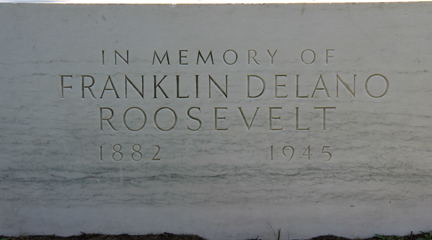
Historian Christopher Hamner visits the original Franklin D. Roosevelt Memorial with educators. They consider the …