FDR's Fireside Chats
Transcript
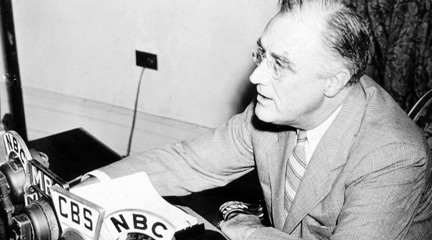
It’s a Fireside Chat given April 28, 1935, in the White House Diplomatic Reception Room, one of the 27 fireside chats that FDR gave and it’s on the Works Relief Program, when he’s really trying to force the Congress to address the issues that didn’t get attention in the first two years of his inauguration.
You know, historians often talk about the first New Deal and the second New Deal as if there were clear benchmarks, that there were clear, like, highways down the middle that divided the two. I think it’s easier, really, to talk about when you look at this document, to look at the overarching goals that FDR had for the New Deal and what the problems were that he confronted when he came into office.
He says, “Our responsibility is to all the people in this country. There’s a great national crusade to destroy enforced idleness which is an enemy of the human spirit generated by this Depression.” FDR believed that confidence and action were essential to confronting the Depression individually, collectively, and politically.
The purpose of this is to show the American people that the Roosevelts care, that the economy is fundamentally sound and that what is just as important as solid government policy is their confidence in themselves and in the government to get through this, because America is the only society in the history of the world from the beginning of time—the history of the world—not to have a violent revolution and an overthrow of the government when their economy tanked.
When FDR comes into office he is elected in November 1932, and he will not take office until March so there’s a five-month dead time or political vacuum, if you will, where FDR’s trying to get a handle on how best to deal with the great crisis in the country.
Now, historians disagree on how pervasive the Great Depression was. What they do agree on is that it’s the greatest depression in American history. The day he takes the oath of office, the vast majority of farms in Mississippi were on the auction block. At the same time that this Fireside Chat will occur, the Midwest will have a horrific dust bowl. So you had a natural crisis, you had an economic crisis, and you had a great crisis of confidence.
The Great Depression starts really the day World War I ends, not just because of the Treaty of Versailles but because the farm economy goes into the toilet. And so when the farm economy, which is almost 50 percent of the American economy at that point, goes into the toilet, that has a significant impact on people’s ability to purchase, to buy goods and that has a huge impact on inventories which has a huge impact on manufacturing which has a huge impact on small business, has a huge impact on bank loans, and so it’s a downward cycle.
What FDR fundamentally believes is that the Great Depression is as much psychological as it is economic and so what he wants people to believe is that it can get better. And his fundamental approach, what he will call this great national crusade, is to get business and citizens working together for the common good. Capitalism and government for a united purpose that serves not only small vested interests or business interests or individual selfishness, but the common good. And there’s still poor, but the gap is narrowed.
So when FDR comes into office in March of 1933, he’s got to deal with a banking system that is in shambles. People are taking out their savings because they don’t trust the banks. A third of the banks have shut their doors, have collapsed, so what FDR first has to do is to prop up the banks.
The next thing he’s got to do is prop up the agricultural economy because agriculture is where the vast majority of unemployment is. Once FDR gets the banking system set up, he deals with the two fundamental sectors of the American economy—business and agriculture. And agriculture is dealt with the Agricultural Adjustment Act because it’s the issues of over-production and under-consumption. So FDR says to the farmers, listen, we got to control over-production which means that you can’t use all of your land. But the government wants to help you and not penalize you for doing this, so if you take 10 percent of your land out of cultivation, if you leave it fallow, then the government will pay you 10 percent of what you made last year to help make up for that loss.
So, once FDR deals with the farm economy, he’s got to deal with big business and small business. The legislation is the National Industrial Recovery Act, the NIRA. It sets up the NRA, the National Recovery Administration. Now, instead of saying, okay, take 10 percent of your business aside and we’ll pay you, they set up a gazillion codes—price codes and wage codes. And if you adhered to it, you got this great blue eagle that you put in your window as this great government seal that says “we do our part,” you know. And what’re you doing, what is your part?
By 1935, the economy is back to where it was in 1929. It’s back to where it was when the stock market crashed, but the stock market is not the beginning of the Great Depression. It’s when the Great Depression hit the middle class.
And so what FDR realizes in 1935 is that he has to take additional steps to deal with these crises because the big overarching programs, the Agricultural Adjustment Act, the National Recovery Administration, are not dealing with the problems in as comprehensive and widespread way as FDR wants.
So how does FDR navigate this?
Well, he’s got a great Democratic majority in 1934 because the Democrats really come back and take over Congress, so he’s got to capitalize on this good will. He’s got to address his critics and he’s got to address the American people to get them involved.
FDR is getting ready to present all of this legislation in 1935 and it’s this together that’s collectively known as the second New Deal. And so when FDR begins to do this, he understands how to talk. He can talk to the American people without being condescending. Whenever FDR was on the radio, as many people listened to FDR as listened to Amos & Andy which was the most popular show on the radio.
It is a remarkable study in power and in conversation. It’s not a press conference. It’s more like a graduate tutorial to the American public on how relief policy is going to work and the extents, the limits and successes, that his early policies have put into play. He talks about how far they’ve come, but clearly there’s much more to do.
He does believe, if you look at this, that America has to get away from the trees and look at the forest. He talks about getting out of Washington and going to Hyde Park or going to Georgia. I mean, that’s a great metaphor, but it’s a metaphor not just for him. It’s also a metaphor for the American people. Don’t just think about you. Think about the country as a whole.
You get a real clear picture of how smart FDR thought the American people were. I mean he’s talking to them about checks and balances. He’s talking to them about laying out a whole new vision. This is what the vision’s going to be based on.
One of the reasons that this speech is so detailed is that it’s a conceptual speech. He’s laying out the vision. He wants America to buy into the vision without getting distracted by the details. He’s going to say this is the hull of the boat, this is the framework. This is where the boat’s going to go.
Let’s think about the ship building analogy that he uses at the start. All you know is it’s a ship and so FDR’s saying the economy and recovery is like a ship. And so what he’s doing is he’s getting the American people to visualize as they sit around this radio the construction of a boat. And then what can happen in their local community if the state and federal government partner together to address issues of concern in that community in a way that puts a significant number of the unemployed and those who are on the relief rolls back to work.
He gives you six clear principles. He calls them six fundamental principles that govern all projects that will receive federal funding. The first is they’ve got to be useful. Now, useful is a great word because you can interpret it any way you want. We need post offices, right? So the WPA builds a boatload of post offices which are incredibly useful.
FDR signs the Executive Order creating the Federal One Programs. And the Federal One Programs are the Federal Writers Project, the Federal Theater Project, the Federal Dance Project, and the Federal Arts Project. It’s useful because it puts people to work.
The second thing: “Projects shall be of a nature that a considerable portion of the money spent shall go into wages for labor.” What this is saying is the money has to be targeted to workers and the auditing of the books will pay very close attention to that.
“In all cases, the project must be of a character to give employment to those on a relief roll.” Sure, it’s federal money and, sure, there’re federal guidelines, but they’re local projects. They’re local projects that are set up by county boards, by school systems, by state agencies, and this, by and large, it’s a compromise that FDR made to get it through because local groups think that they should control the money.
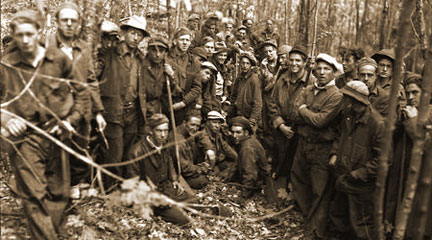
From its inception in 1935 until Congress withdraws funding for it in 1943, the WPA has an enormous impact on the United States. Seventy-five percent of this was targeted toward construction. Why? What we need is we need projects that will benefit the country, but that also will put huge numbers of Americans to work fast in ways that gives them new job skills. So let’s take people that might have been janitors and let’s teach them how to be carpenters. So let’s not only construct, but let’s have on-the-job training that will enhance people’s job skills and make them more employable and give them more skills to which they can market themselves once they get off relief.
One of the ways that FDR changed the government was expanding the role the government had in managing the economy and he did this in several ways. He did this with the Banking Act, with the Emergency Banking Act, which set up standards, regulatory standards, practices for banks that banks had to meet in order to be federally insured.
Let’s look at the National Labor Relations Act or the Wagner Act. This said, for the first time in our history, the first time, that it was legal for a worker to join a trade union.
Then let’s look at Social Security. The government began to set up a retirement system for the American public. What FDR hoped would happen would be a three-pronged stool of Social Security payments, corporate retirements or, you know, company pensions, and individual savings.
The other thing that FDR did was with the income tax, with the graduated income tax. Have it taken out of your paycheck rather than having you to have to write the check at the end of the year. So they really helped set a way to manage the cash flow of the federal government.
He also put the federal government in some cases in direct competition with private industry to spur private investment. So we have the federal government involved in almost every aspect of the American economy, from regulating the stock market and setting rules for how much you had to have in the bank to buy stocks on margin, what standards banks had to meet to be healthy, how you insured deposits in the bank, how you addressed the issues of over-production and under-consumption in the farm economy. How do you deal with the volatility of a skilled and unskilled labor force? How do you deal with labor conflict, organized labor conflict between labor and management? How do you deal with reforming the income tax system and how do you deal with the federal government controlling the way that monies are spent in the states.
So in many ways, what the New Deal did was establish the tax policy, the wage policy, the farm policy, the banking policy, the utility policy that govern modern America. When, you’d never have the Great Society. You’d never have public housing. You’d never have the National Endowment for the Humanities. You’d never have federal aid to education. You’d never have Medicaid and Medicare and Social Security indexed to the cost of living if you didn’t have the New Deal because the New Deal is the bedrock. It’s the platform upon which all modern government policies are based. Because the bottom line for this is that the New Deal said that the government had a role to play in propping up capitalism in a way that benefited the broadest number of Americans.
Historian Allida Black analyzes FDR’s April 28, 1935 Fireside Chat. What ideas and arguments does FDR present to the American people? What does his speech say about his goals for the New Deal?