A Close Look at the World War II Memorial
Transcript
Christopher Hamner: We’re standing right in front of the World War II Memorial; how many of you have visited it before? Okay, great. I want to talk a little bit about why it’s here and what it looks like, and then give you some time to explore a little bit. But I don’t think you can really understand why the memorial looks the way that it does without knowing a little bit about a totally different memorial—the Vietnam War Memorial. So how many of you have been to the Vietnam War Memorial? Okay, great, just about everybody. What have your experiences been?
Teacher 1: Very somber.
Christopher Hamner: Okay, somber, absolutely.
Teacher 2: Dark.
Christopher Hamner: Yeah, no, it’s somber, it’s dark.
Teacher 3: Emotional because it has the little book with the names and relatives.
Christopher Hamner: Yeah, I mean draws you in, it can be incredibly emotional because it has become a destination point for a lot of the people who served in the Vietnam conflict, people leave things there, they’ll take rubbings of people they knew—it’s interactive in a way that not many memorials are. It has its own really interesting story; the story of the Vietnam Memorial goes back to the mid-’70s. It was a project started by a veteran of the Vietnam conflict who saw the movie Deer Hunter, which took him back to his own experiences fighting in the war. He said he stayed up all night and that the next morning he told his wife that he was going to dedicate himself to raising money for a memorial to the people that he had served with in Vietnam. The monument that you think of as the Vietnam Memorial, which is the wall—that V-shaped wall that sort of starts low and rises to a peak of I think 6 or 7 feet and has the names inscribed on it—is actually only one of three Vietnam Memorials that are in the same place. And in 2012, we know this as one of the most moving monuments, a place where people will come from across the country to connect with it. It was incredibly controversial at first, and that’s a part of the story that we often tune out. But it has a backstory. As they raised money they began to solicit designs for the memorial. And I talked to you guys this morning when we were at the Grant Memorial, and we’ve talked a lot of times about all sorts of historical sources, that things are made, they don’t just appear, and they’re designed by a person or a committee who wants to get an idea out there. The Vietnam Memorial is a little unusual in that they opened a design contest nationally. And somewhat atypically they did the jury review blind. Architecture—architects and designers could put forth a plan for what the memorial might look like, and then they submitted it. They all went out to a big hanger like at Dulles Airport. But all the information about who had designed it and who they were and what their background was was all stripped off, so that the judges were only looking at the idea itself. And the design that you know of as “The Design” was one of the last two dozen and then one of the last nine and then the last three and it was ultimately the one that was selected. The selection and the unveiling of the design—before it was even built—went off like a bombshell. One of the groups that was most opposed to it was Vietnam War veterans. They were opposed to a number of things. One was the design of it. It is a somber memorial, it is black, it is anti-heroic, I think, in some ways. Did anybody see as we were walking over here on Constitution, happen to look over at the statue of the gold arm holding up a sword with flames? Okay, so what was that? Anybody catch it?
Teacher 4: St. Michael or something wasn’t it?
Teacher 5: World War I, was it Second Division?
Christopher Hamner: It was a monument to the Second Infantry Division and its losses in the First World War. You saw the arm holding up the flaming sword and then a list of all the battles that the Second Division fought in. That’s much more of a kind of typical, classic war memorial. You put up a leader, or you put up something—a lion or an eagle or wreathes or something that has classical overtones and celebrates the heroism—and that is not what the Vietnam Memorial is. It was designed very specifically. The designer said that it was designed to get people to interact with it; it has the names of all of the people that were killed during the decade or so of the conflict. How are they organized?
Teacher 6: The middle is the earliest and then it goes out to the side.
Christopher Hamner: They’re organized chronologically in the order that the people died. So you cannot go and just alphabetically find the person that you want to find. That design forces you to look at a lot more of it than you would if you could just go right to the person you were looking for. You have to look over all of the names, or a lot more of the names, and it forces you to engage with it. What’s the finish like, can anybody remember?
Multiple Teachers: It’s reflective.
Christopher Hamner: The finish of the black marble is highly reflective. So as you’re looking at the names you can also see your own face reflected in it. That’s by design too. None of this was done accidentally. It encourages you to put yourself in the middle of these people and to think about the sacrifice and to think about it in very personal terms. The other thing that became a big issue with the design was the identity of the designer itself. Her name was Maya Lin. She was a 20-year-old Yale architecture student—so she was very young to win such a prestigious national competition—she was female, and she was Asian. None of those things sat particularly well with a vocal group of Vietnam veterans who felt that everything about the memorial was wrong—the location of it, the tone of it, the somberness of it. You can absolutely see where they’re coming from. If you look around at most war memorials and you see that they celebrate heroism and glory and sacrifice, you might think this is not how I want my time, my conflict, to be remembered. This isn’t what I want people thinking about. That was a really legitimate point, but it opens up this whole question of: Who is the memorial for?
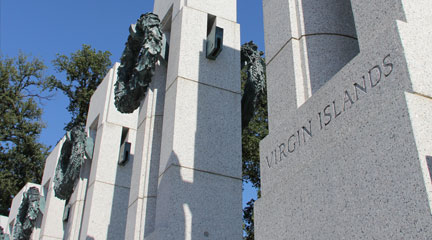
Christopher Hamner: So despite the fact that the Second World War was fought after—or before the Vietnam War by 25 years or so, the World War II Memorial was actually started 15 years after the Vietnam Memorial. To my eye, a big part of what the World War II Memorial is about is not being controversial. That they did not want to open a similar can of worms about how are we going to celebrate this, how are we going to commemorate it, who is it for? It bends over backwards and goes to great lengths not to be controversial. And in a way kind of just dilutes it to a point where it doesn’t say anything controversial, but I also don’t know that it says all that much. People have pointed out that it’s very classically derived. Curiously it actually looks like a lot of the memorials that the German architect Albert Speer built in Berlin during the Second World War as part of the Nazi government. Which is weird, because it’s a memorial that looks a little bit like the architecture of the country that it’s built to celebrate the defeat of. But you notice it’s got 50-some plinths and they each have wreaths. Has anybody who’s seen this before noticed how the plinths are organized?
Teacher 1: By state, that’s all I know.
Christopher Hamner: By state, so every state and then some of the U.S. protectorates, Guam, the Virgin Islands. When you’re standing you can take a little bit closer look, there’s Wyoming, Washington, South Dakota, Nevada, Kansas, Minnesota. That’s interesting as a historian in that the states really had nothing to do with the way the war was fought. In the Civil War that was more true, people went off with the people from their home state, from their home town. But the Second World War deliberately didn’t do that. They mixed people from Iowa and Florida and Alabama and Massachusetts in the same units. So it’s not like the states went forward to fight. And it’s not like the state governments had much of a role in the Second World War. The Second World War was very much the federal government’s achievement. So to organized the wreathed tributes, which are the big outer ring, why do you do that?
Teacher 2: It could be honoring the dead from each state.
Christopher Hamner: It could be. I’ll buy that. Why not do it by the different military units that fought, you know, the First Division, the Second Division, the Fourth Division.
Teacher 3: It could be just underscoring that it’s the United States, as opposed to—
Christopher Hamner: And the circle, I think, does that and pulls it together.
Teacher 4: It sounds like they designed by committee.
Christopher Hamner: Yes, which is exactly what this was. The committee was formed in the mid-1990s, there was a real push by members of Congress who were World War II veterans themselves, and who said—quite reasonably—that this generation is not going to be around forever; we need to celebrate and commemorate their sacrifice and their achievement while they’re still here to appreciate it. Then the design went through a series of committee decisions, which the Vietnam Memorial didn’t, you know the Vietnam Memorial is one person’s vision. Partly the decisions here reflect a desire to make sure that there’s just nothing controversial about it. If you put it in by state and there’s really nothing to—that could possibly be controversial about that—because everybody came from a state or a protectorate—but at the same time it doesn’t really say much about the war. It just sort of recognizes the fact that there were four dozen entities that are there. Then you’ve got the big arches—one represents the European Theatre, one represents the Pacific Theatre, the two big fountains, it’s like the freedom palisade. But everything is, I think, kind of homogenized in a way to make sure that it’s not too controversial. There’s not much in there that would get somebody saying this is an inaccurate way to portray my experience.
Teacher 5: The order of the states, is it like—
Christopher Hamner: I have no idea, I have not been able to figure that out!
Teacher 5: Well I was wondering is it the same thing like on the Lincoln Memorial.
Teacher 6: No, there is an order and it’s in the brochure.
Teacher 7: It says they alternate to the right and left of the field of stars based on when they entered the Union. Delaware was the first state.
Christopher Hamner: So it is the order that they entered, but it goes back and forth…
Teacher 6: That’s bizarre.
Christopher Hamner: That’s just weird. For those of you who were with us this summer when we talked about the Enola Gay at the Smithsonian. That was 1995, the big brouhaha about how are you going to display the plane that dropped the atomic bomb on Hiroshima. The Air and Space Museum is right over there. And remember, that was a hugely controversial issue, they never wound up mounting the exhibit, several people who had backed it lost their jobs. That’s in the recent memory of the people who are putting this together. Who I think wanted to make a memorial that could be the center where people could gather, something that was inoffensive to veterans, and to the families of veterans. But as a result I just don’t think there’s all that much there.
Historian Christopher Hamner introduces educators to the World War II Memorial in Washington, DC. He places the memorial in context: How does the story of its construction contrast with that of the Vietnam Veterans Memorial? Who was the World War II Memorial built for? What was its design intended to convey?